Project Sentinel

A National Resilience Campaign

Give Britain back its eyes and ears.

Project Sentinel is a campaign to rebuild the Royal Observer Corps for the modern age, a national network of trained, vetted volunteers who watch the skies, report what they see, and help their communities when drones, floods or attack overwhelm the systems we depend on.

A volunteer observer scanning the sky at dawn on a British hillside
On watch
1925
When Britain first stood up the Observer Corps
1995
Stood down, three decades of cover lost
12 mo
To a working pilot from the day it is approved
<£450
Cost of a drone that can slip under our radar

The Emergency

The threats evolved. Britain stood still.

The danger to Britain is no longer distant or theoretical. The head of the Armed Forces has warned the risks are the gravest since the Cold War, and the front line now runs through ordinary places: the airfield down the road, the flooded high street, the prison on the edge of town.

Cheap drones, no warning

Small, low, slow aircraft, some made of cardboard, most costing less than a laptop, fly under radar built for fast jets. They loiter over prisons, airfields, ports and power stations. Our high-end defences were never designed to see them.

Floods and extreme weather

Storms and flooding now arrive harder and more often. When roads close and the lights go out, the first need is simple: someone local who can see what is happening and report it to the people who can help.

Comms down, sabotage up

Cables are cut, networks jammed, infrastructure probed. When the technical picture goes dark, decisions still have to be made. Trained eyes on the ground are the backup that cannot be switched off.

The Army stretched thin

Today the Armed Forces are Britain’s civil-emergency backstop of last resort. If they are committed elsewhere, there is a gap, and the head of the Armed Forces has warned the risks are the gravest since the Cold War.

“The first useful question in any crisis is the simplest: what is actually happening, exactly where, and what help is needed now?”
The gap Project Sentinel is built to fill
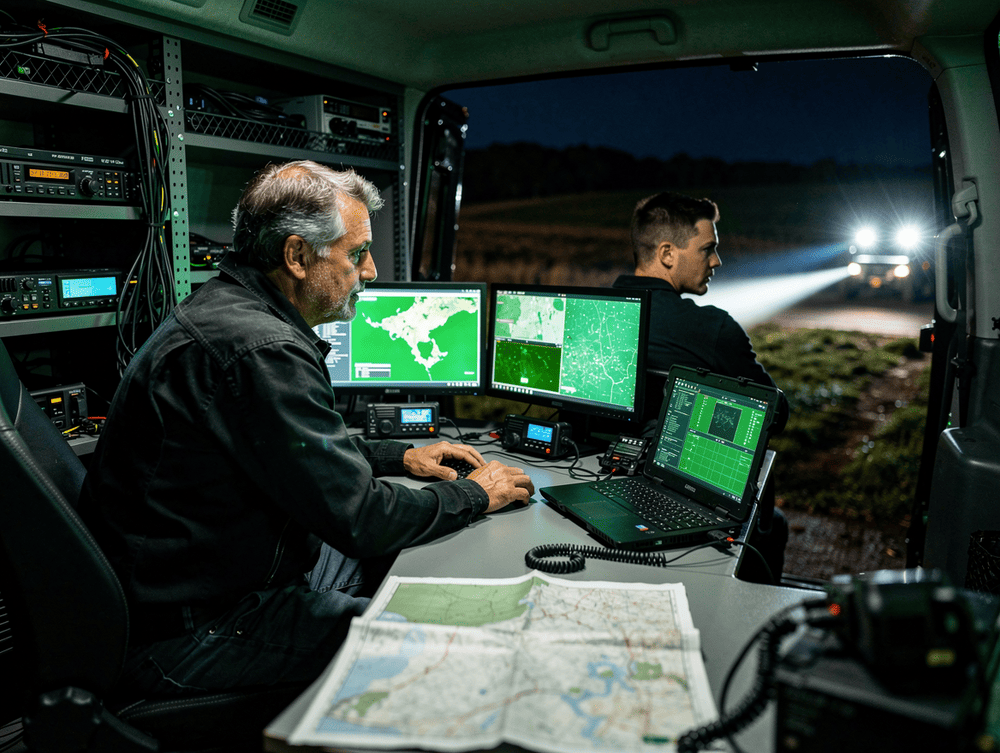
Interior of a compact trailer-based mobile command centre at night. Two operators (one older, one younger) study glowing green map and sensor screens; soft emerald light on their faces

What It Is

A human sensor network for Britain.

It is a modern, dual-use volunteer corps: trained people, in known local places, reporting through known channels, ready to serve defence and civil emergencies alike. It does not replace radar, the RAF, or the blue-light services. It is the human layer underneath them, watching the ground they cannot.

Watch

Trained, vetted volunteers in fixed local places, the people who already know the roads, hills, estates, flood points and skylines of their patch.

Report

Disciplined, structured reporting through recognised channels, turning a sighting into ground truth the RAF and emergency services can act on.

Assist

Practical help where it lands: welfare and rest centres, logistics, first aid and casualty support, alongside Britain’s blue-light responders.

The Precedent

Britain built this once. It worked.

The oldest idea in air defence, made modern. From 1925, Britain ran a national network of volunteer watchers, uniformed, disciplined, rooted in every county. They tracked raiders in the Battle of Britain when radar could not see inland, and reported nuclear bursts through the Cold War.

It was a quiet success story for seventy years. Then, in 1995, it was stood down, and nothing replaced it. Project Sentinel is the case for building that capability again, for the threats we actually face today.

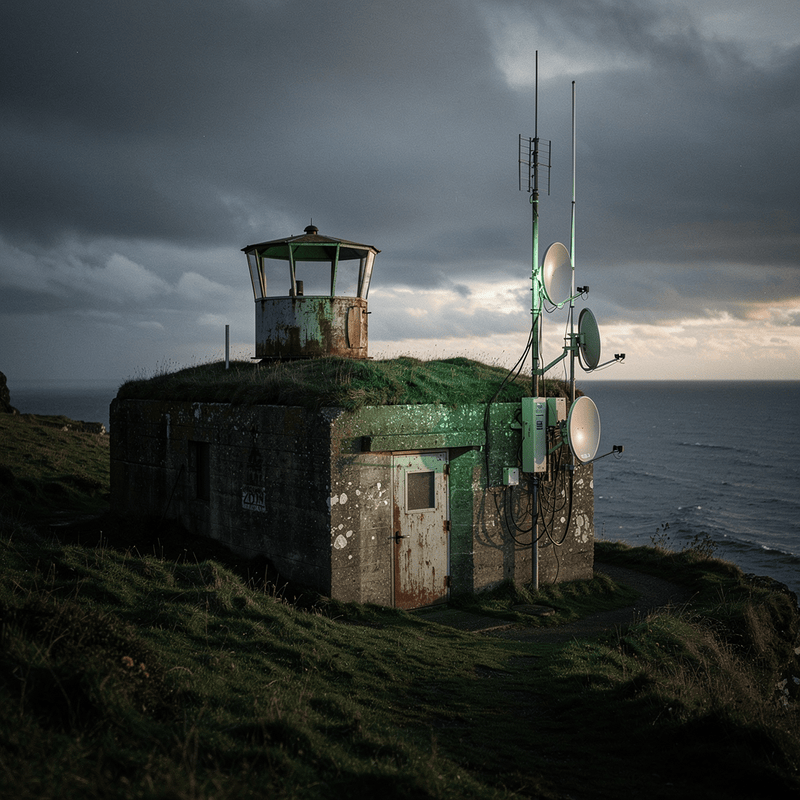
A restored Cold War-era observation post on a green British clifftop at dusk
  1. 1925

    The Observer Corps is founded to watch Britain’s skies.

  2. 1940

    Tracks incoming raiders in the Battle of Britain, radar’s inland eyes.

  3. 1955–91

    Re-roled for the Cold War: nuclear burst and fallout reporting.

  4. 1995

    Stood down. Three decades on, the gap is still open.

The Case in Brief

Britain already knows how to do this.

It has the people, the precedent and the structures. What it lacks is the decision.

Britain needs trained people in local places who can observe, report, assist and endure when national systems are under pressure. That is the whole idea, and the country has built it before.

Project Sentinel is a low-risk, high-value plan to restore a nationally distributed volunteer observation and resilience capability, directly modelled on the Royal Observer Corps (ROC) and the United Kingdom Warning and Monitoring Organisation (UKWMO) that served Britain so well through the Cold War.

It is deliberately dual-use. It provides ground-truth reporting and support to military operations while strengthening the civil response to emergencies. It needs no new bureaucracy: it modernises and reactivates a proven framework under clear command, the RAF for military tasks, civil resilience structures for emergencies.

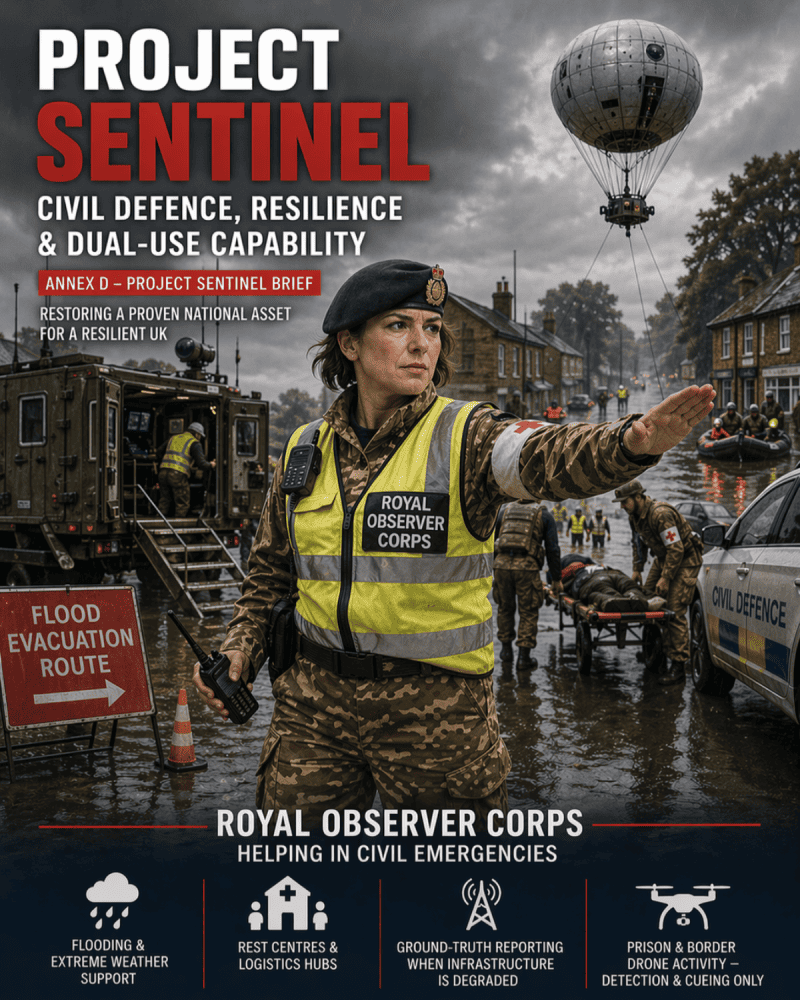
Modern uses include support to floods and major incidents, cueing when communications are degraded, spotting and tracking drone activity around prisons and borders, logistics and rest-centre help, and advanced first aid and casualty evacuation.

The precedent is real and recent. Former Observer Corps volunteers built Nightingale hospital wards and decontaminated ambulances during COVID, proof the ethos endures decades after stand-down. And Sweden, Denmark, Norway and Finland still deliver exactly this dual military-civil effect today. Britain can do the same, quickly and at modest cost.
It Already Works

Proven here. Proven abroad. Proven recently.

This is not an experiment. Allied nations run volunteer observation and home-guard forces today, and Britain’s own veterans showed, during COVID, that the will to serve never left.

🇸🇪 Sweden

Hemvärnet, the Home Guard

A standing volunteer force woven into national defence and civil crisis response. Tens of thousands strong, and growing.

🇩🇰 Denmark

Luftmeldekorpset

A volunteer air-observation corps kept exactly for the low, local watching that radar cannot do alone.

🇺🇦 Ukraine

Human-sensor networks

Ordinary people reporting low, cheap drones in real time have repeatedly proven the value of persistent ground-level observation.

🇬🇧 United Kingdom

COVID, 2020

Former Observer Corps volunteers built Nightingale hospital wards and decontaminated ambulances, 25 years after the Corps stood down.

The Ask

Don’t wait for the next crisis to wish we had this.

Project Sentinel needs no new department, no new headquarters, no blank cheque. It needs a minister to say yes to a pilot. Add your name, send it to someone who can move it forward, and help force the decision while there is still time.

The price of freedom is eternal vigilance