The Corps Britain Already Built Once
For most of the 20th century, Britain ran a national network of volunteer watchers. It worked. It was stood down. The need never went away.
Project Sentinel starts from a simple fact: Britain has already built this kind of national volunteer observation capability once, and it worked.
The Royal Observer Corps formed the backbone of the United Kingdom Warning and Monitoring Organisation during the Cold War. It gave the country trained people, local posts, disciplined reporting, and a national framework for ground truth when technical systems were not enough.
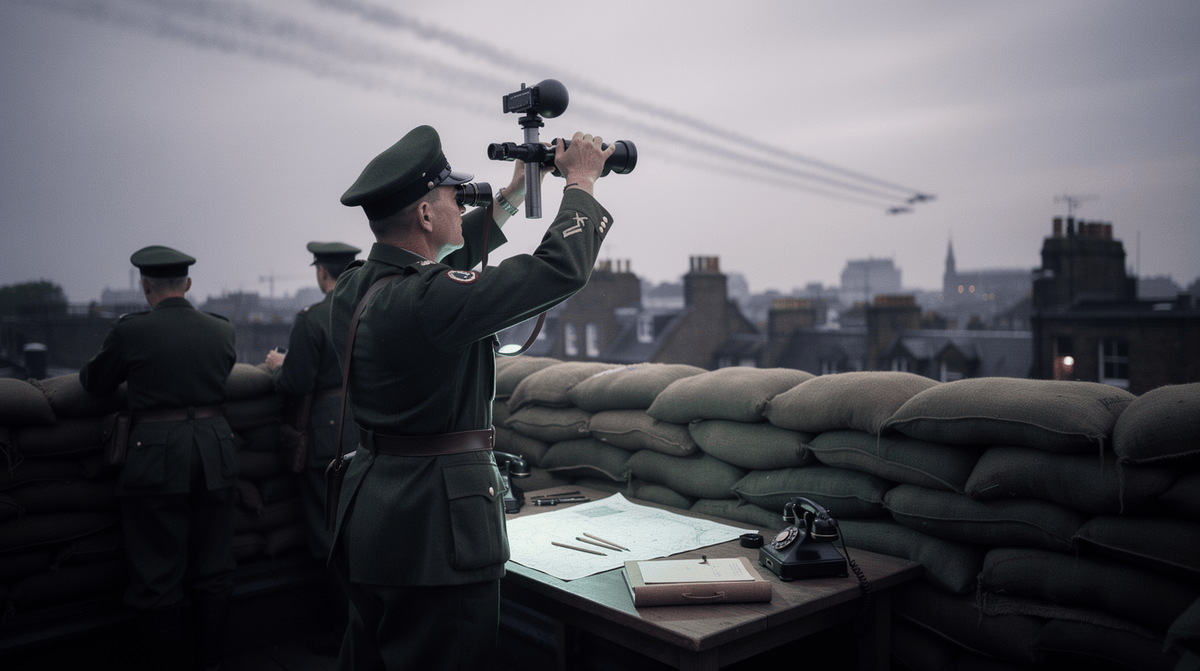
What an Observer Corps actually is
An observer corps is the oldest idea in air defence made modern: ordinary people, trained and organised, stationed across the country to watch, identify and report what passes overhead and what is happening on the ground.
The Observer Corps was formed in 1925 to provide early warning of approaching aircraft, and during the Second World War it played a critical role in the air defence of the United Kingdom. Its contribution during the Battle of Britain was so significant that, in 1941, King George VI granted the Corps the title Royal Observer Corps, the only unit to receive this honour during the war. The Corps went on to play a major part in the Battle of the Atlantic and provided vital support during the D-Day landings.
After 1945 the Corps adapted to the nuclear age. During the Cold War, Observers moved from above-ground posts to a network of protected underground bunkers as part of the United Kingdom Warning and Monitoring Organisation (UKWMO), detecting and reporting nuclear bursts and subsequent fallout to provide the ground truth essential to national survival planning. The Royal Observer Corps finally stood down in 1995, after seventy years of continuous service, but the underlying requirement for trusted, locally based observers who can operate when technical systems are degraded or overwhelmed has never gone away.
What it proved
A distributed volunteer force gives Britain things technology alone cannot: human eyes and judgement on the ground, deep local knowledge, surge capacity at no standing cost, and trust built into the community.
The historic ROC proved it through decades of service. The Nordic home guards and air-reporting corps prove it again every year. The model is not nostalgia, it is a capability that keeps earning its place.
The gap left behind
The post-Cold War drawdown of specialist volunteer observation left a gap that has never been filled. Technical sensors and centralised command are vital, but they have proven vulnerable to saturation, jamming, cyber attack, or simple overload during real events, from major floods to the early days of COVID.
Thirty years on, the threats have changed shape and the gap has only grown. The honest question is not whether the old Corps was useful, but why Britain still has no modern equivalent.
The network still had value
During the COVID pandemic, members of ROCA No 13 (Carmarthen) Group volunteered to build beds and fit out wards at the Nightingale Hospital in Cardiff, and to decontaminate ambulances at Morriston Hospital in Swansea, a quarter of a century after the Corps formally stood down.
It was a small thing and a telling one. The uniforms had been packed away for decades, but the instinct to muster, organise and serve was still there. Project Sentinel exists to give that instinct a structure again.
The Ask
A capability Britain can stand up before the next crisis, not after it.
Project Sentinel needs no new department, no new headquarters, no blank cheque. It needs a decision to fund a pilot. Get in touch, share it with anyone who can take it forward, and help move the proposal from paper to a working capability.